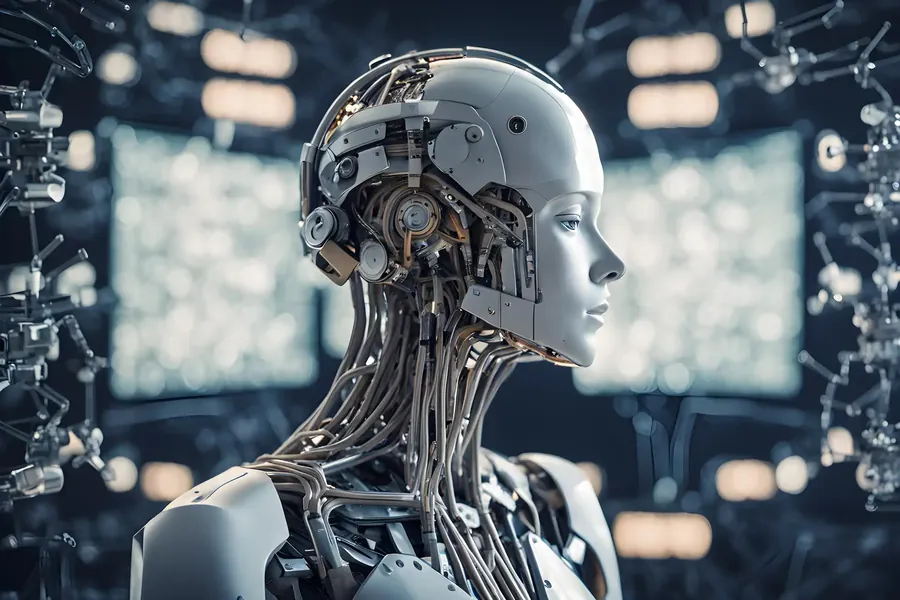
Robotics · The two-legged bet
Humanoids leave the lab
For twenty years the walking robot was a trade fair attraction. Now a dozen companies are building them by the hundred and a few are being paid for work. What changed is not the legs.
The demonstration that made humanoid robots famous was a back flip. The demonstration that matters is a machine standing at a table for eight hours, picking parts out of a bin without a person watching it. One of those is a control problem that was solved years ago. The other is the reason humanoids were a research project for two decades and are now a product category with real money behind it.
Why a human shape at all
The engineering argument against a humanoid is overwhelming. Legs are a terrible way to move a payload across a flat floor. Wheels are cheaper, faster, more efficient and almost impossible to tip over. A robot arm bolted to a table does more work per euro than any walking machine will for years. Every industrial roboticist knows this, and most of them said so loudly while the first humanoid programs were being funded.
The argument for the human shape is not about the robot. It is about the building. Factories, warehouses, kitchens and hospitals are full of stairs, door handles, tool racks, pallets at knee height and shelves at shoulder height, all sized for a person. Changing a machine is a purchase. Changing a building is a project. A machine that fits the spaces we already have can be deployed without an architect, and can be moved to a different task on a Tuesday without a rebuild.
That is the whole bet: general-purpose hardware amortised across many tasks beats specialised hardware that has to be justified task by task. It is the same bet the personal computer won against the dedicated word processor, and it took the computer fifteen years.
What actually changed
Three things arrived at once, and none of them is a leg.
Actuators got cheap. The electric motors, gearboxes and drivers that move a joint came down in price on the back of electric cars and drones. A humanoid needs between twenty and forty of them. In 2015 that bill alone put the machine out of reach of any commercial case. Today the whole actuator set of a mid-range humanoid costs less than a single research-grade arm did a decade ago.
Perception stopped being the hard part. Cameras plus a neural network now do in real time what needed a laboratory, a calibration ritual and a controlled light level. A robot that can reliably find the edge of an object in a cluttered bin is a robot that can be useful in an uncontrolled room.
Control moved from rules to learning. The old way to make a robot pick something up was to write the motion. The new way is to train a policy on demonstrations and simulation, and to let it generalise. This is the change that matters most, and it is covered in its own read on robot foundation models.
What they are actually doing in 2026
Almost every deployment you can verify is one of four jobs: moving totes between a conveyor and a cart, loading and unloading a machine, inspecting something with a camera at the end of an arm, and sorting parts into containers. These are all tasks that a fixed robot could do, in buildings where a fixed robot would have needed a cell, a fence and a floor plan.
The unit counts are small. A pilot is five to fifty machines, not five thousand. The machines are supervised, often by an operator who can take control remotely when the robot stops. That supervision is not a failure of the technology; it is how the training data for the next version is collected.
The three numbers that decide this
Ignore the demo videos and watch these instead.
Uptime. A robot that works for two hours and charges for one is a robot with a 66 percent duty cycle before anything goes wrong. Battery swaps, hot-swappable packs and docking behaviour matter more to the business case than peak speed.
Mean time between interventions. How many minutes of work happen between the moments a human has to touch the machine. Pilots that report this honestly are usually in the tens of minutes. Useful deployment starts somewhere in the tens of hours.
Cost per hour of delivered work. Purchase plus integration plus maintenance, divided by hours actually worked. This is the only number that can be compared with a wage, and it is the one our automation payback calculator is built around. At 100,000 dollars over five years with a 60 percent duty cycle on two shifts, you land near five dollars an hour before maintenance, which is competitive in high-wage countries and nowhere else.
What could still go wrong
The optimistic case assumes hands improve, data compounds and manufacturing scales. All three can stall. Dexterous hands are the least solved part of the machine and the most expensive to build and repair. Training data for physical tasks does not exist on the internet the way text does, so every company is paying to create it. And a machine that works in a clean pilot bay can fail on a floor with spilled oil, bad light and a pallet in the wrong place.
There is also a quiet competitive answer: for many of these jobs, a wheeled base with one good arm does the work at a third of the price. The humanoid has to be general enough to beat that, or it is an expensive way to move a tote.
What to watch next
Watch for the first published contract that pays per hour of work rather than per machine. Watch for a manufacturer quoting a spare-parts price list, because that is what a product has and a prototype does not. And watch the hands.
Questions readers ask
Are humanoid robots actually working in factories today?
Yes, in pilots, in small numbers, on a narrow set of tasks such as moving totes and loading machines, usually with human supervision available. What does not yet exist is a large fleet doing varied work unattended.
How much does a humanoid robot cost?
Manufacturers talk about 50,000 to 150,000 dollars at volume, but pilot machines change hands for more and the purchase price is rarely the largest cost. Integration, safety assessment, maintenance and the hours lost to interventions usually exceed it in year one.
Will humanoids replace warehouse jobs?
Not on current numbers. They are being used where hiring has failed or where a task is unpleasant, and they remove parts of jobs rather than whole ones. The tighter constraint is that a person can be trained in a day and a fleet cannot.
Read next
Read next
 Robotics
Robot foundation models
Robotics
Robot foundation models
The brain moved before the body did
The interesting thing about the current robot wave is not the hardware. It is that a single trained model can now drive many different bodies, and that it learns from video of people rather than from code written for machines.
 Robotics
Dexterity
Robotics
Dexterity
The hand is the hard part
A robot can run, jump and carry a crate. Picking up a strawberry without crushing it is still a research problem, and it is the one standing between humanoids and most of the work they are sold for.
 Robotics
Collaborative robots
Robotics
Collaborative robots
The robot that works next to you
While humanoids get the attention, the machine actually changing small factories is a slow, blunt arm that costs less than a delivery van and needs no cage.
More in this department