AI & Computing · NVIDIA at Jülich
NVIDIA simulates a 104-qubit fault-tolerant quantum processor on JUPITER
Photo: NVIDIA / Forschungszentrum Jülich, Sascha Kreklau
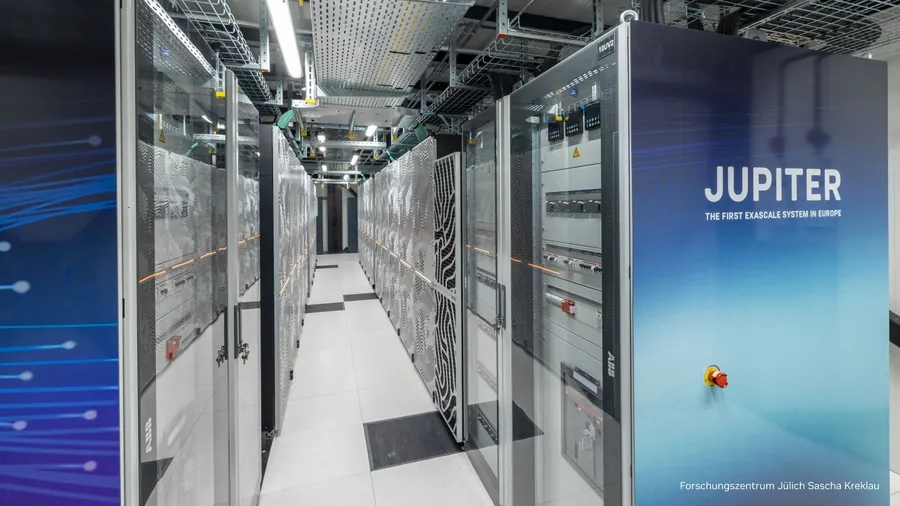
NVIDIA has run the largest full simulation of a fault-tolerant quantum processor so far on JUPITER, Europe's first exascale supercomputer. The 104-qubit model tests a method that needs 90 percent fewer physical qubits than earlier approaches.
Quantum computers are usually discussed as machines of the future. The work NVIDIA announced on 19 October 2026 is about the present: how to learn what a fault-tolerant quantum processor will do before anyone has built one. NVIDIA researchers used JUPITER, the supercomputer at the Jülich Supercomputing Centre and the largest in Europe, to simulate such a processor with 104 qubits. According to the company, no earlier simulation has modelled a quantum processor in this much detail.
Why noise is the whole problem
Qubits work at the edge of what physics allows. Every operation that controls them adds a little noise, and noise turns into errors. A quantum computer that keeps calculating correctly despite those errors is called fault tolerant, and building one is the central engineering task of the field. Our long read on what is real in quantum computing explains why the gap between a physical qubit and a usable logical qubit is so wide.
Fault-tolerant machines depend on so-called magic states: special arrangements of qubits that are consumed continuously while a computation runs and therefore have to be produced again and again. Any method that makes them more cheaply lowers the difficulty of the whole machine. The method NVIDIA examined is called magic state cultivation. It counts as one of the leading approaches and, by NVIDIA's account, needs 90 percent fewer physical qubits than earlier methods.
What the simulation adds
Earlier research at Jülich had simulated 50 qubits under ideal conditions, without any noise. The new run models magic state cultivation under realistic hardware noise. That is the difference between a textbook result and a design tool: engineers can see how errors affect a processor and compare designs before they are built, instead of relying on trial and error in hardware. NVIDIA says the results give the quantum industry actionable insight into the impact of noise and could shorten the path to viable quantum computers by years. It names drug discovery, financial modelling and materials science as fields that would benefit.
The hardware behind it
The obstacle to simulating qubits on classical machines is memory. The amount needed can grow exponentially with the number of qubits, which puts large simulations beyond conventional computing systems. The team therefore worked in stages. An NVIDIA GB200 NVL72 system at the NVIDIA Accelerated Quantum Research Center, NVAQC for short, served as the development platform. There the researchers scaled their tests from four GPUs to several hundred before moving to 8,192 GPUs on JUPITER, which runs on NVIDIA GH200 superchips. The preparation cut a simulation effort of several weeks down to days.
On the software side, the run used NVIDIA cuQuantum for performance and scale, and the fault-tolerant logical layer of the NVIDIA CUDA-Q platform to express the magic state circuit.
Two voices from the project
Jensen Huang, founder and chief executive of NVIDIA, said that useful quantum computing "will require fantastically complex, fault-tolerant systems", and that understanding their behaviour at scale is essential to building them. Kristel Michielsen, director of the Jülich Supercomputing Centre, pointed to Europe's investment in JUPITER, which in her words lets researchers investigate questions "that were previously beyond reach".
What it means for readers of this site
The announcement is a reminder that progress in quantum computing currently runs through classical supercomputers. GPUs are not being replaced by qubits here; they are the test bench on which the qubits of the next decade are designed. The NVIDIA share on our markets page is priced mainly on AI, and simulation work of this kind is a second use for the same chips. Whether magic state cultivation keeps its promise on real hardware remains open. The simulation narrows the question; it does not answer it.
Read next
Read next
 AI & Computing
Quantum
Quantum computing, without the hype and without the sneer
Error correction started working. That is the milestone that matters, and it is why the field went from a permanent ten years away to a schedule with dates in it.
 AI & Computing
The chip race
Everything runs on somebody else’s wafer
The AI boom is a story about three companies, one island and a memory shortage. Understanding where the bottleneck sits explains most of what happens to prices, products and geopolitics.
 AI & Computing
AI in science
The instrument that reads everything
Protein structure prediction won a Nobel prize. Weather forecasting got faster and better. Materials discovery is next. The pattern in each case is the same, and it is not general intelligence.
More in this department